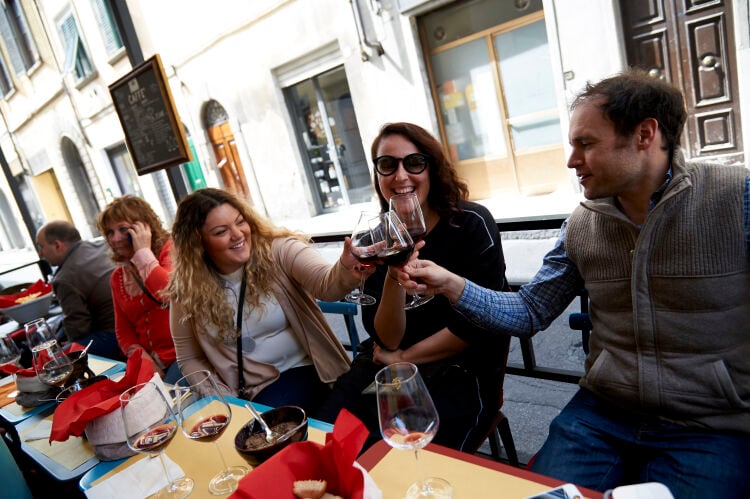
For anyone planning a Florence evening that matters, here are the signs worth reading from the pavement, long before the menu ever lands on the table.
There’s a particular silence that falls over a table when you both know, without either of you saying so, that the restaurant was a mistake. You’re on a terrace off Piazza del Duomo, the dome going gold above you, and in front of you is a plate of pasta that arrived eleven minutes after you ordered it and tastes as though it had been sitting there for eleven hours, while the waiter who pulled you in off the street works the next couple along and, three streets away, a room you’ll never see is only just beginning to fill with Florentines.
The good news is that there’s a reliable way to steer around these places, because a restaurant built for people who won’t come back tends to give itself away from thirty feet, and so does one that’s actually worth your evening, once you know what you’re looking for. Here’s how we find authentic restaurants in Florence: the signs everyone repeats, the ones almost nobody mentions, and where we’d send you to eat instead.
Most of This Is Decided Before You Land
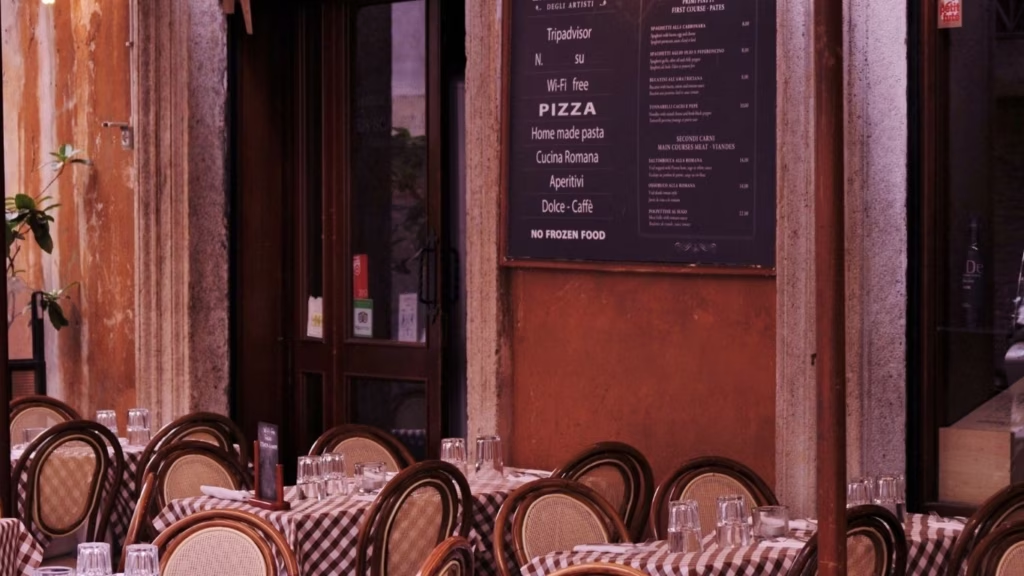
Long before there’s a pavement to stand on, there’s a screen, and that’s where the first traps get set.
Ten thousand reviews measure how many people have walked past a restaurant rather than how good it is, and a place in the centre of Florence with that many reviews isn’t ten thousand times better than one with three hundred, just ten thousand times more findable, which is a different quality altogether and not one you can taste. When we’re checking somewhere new, we scroll straight to the recent reviews written in Italian, and if there aren’t any, we’ve usually learned what we came to learn.
We’d treat whatever your social feed hands you with the same caution, since a fair share of Florence’s “hidden gems” are paid placements, and the giveaway is that everyone seems to be filming the same dish from the same angle, in the same light, with the same slow tilt of the plate. An empty diary is worth questioning too. If a table for two at half past eight on a Saturday is still sitting open at four in the afternoon, somebody local has already made a decision about that place.
One list is worth more than all the aggregated ones put together. Vetrina Toscana is run by the Tuscany Region with Unioncamere Toscana, and it catalogues around a thousand restaurants that have put their name to cooking with Tuscan produce. It won’t tell you whether the lighting is kind or the tables sit close together, but nobody has paid to appear on it, which these days is nearly exotic.
The Signs You Can Read from the Street
Florence is a small city, and most of it can be covered on foot if you slow down enough to read it, as the official FeelFlorence city guide will tell you too, which is just as well, since a romantic dinner here is very often saved or lost in the thirty seconds spent outside the door.
A restaurant worth your evening rarely has someone outside trying to pull you in, because the kitchens people talk about here are already known by the people who’ve eaten in them. Word travels fast in a city this size, and it travels in Italian, so their tables fill on their own, with people who’ve been coming for a decade and will be back in a fortnight.
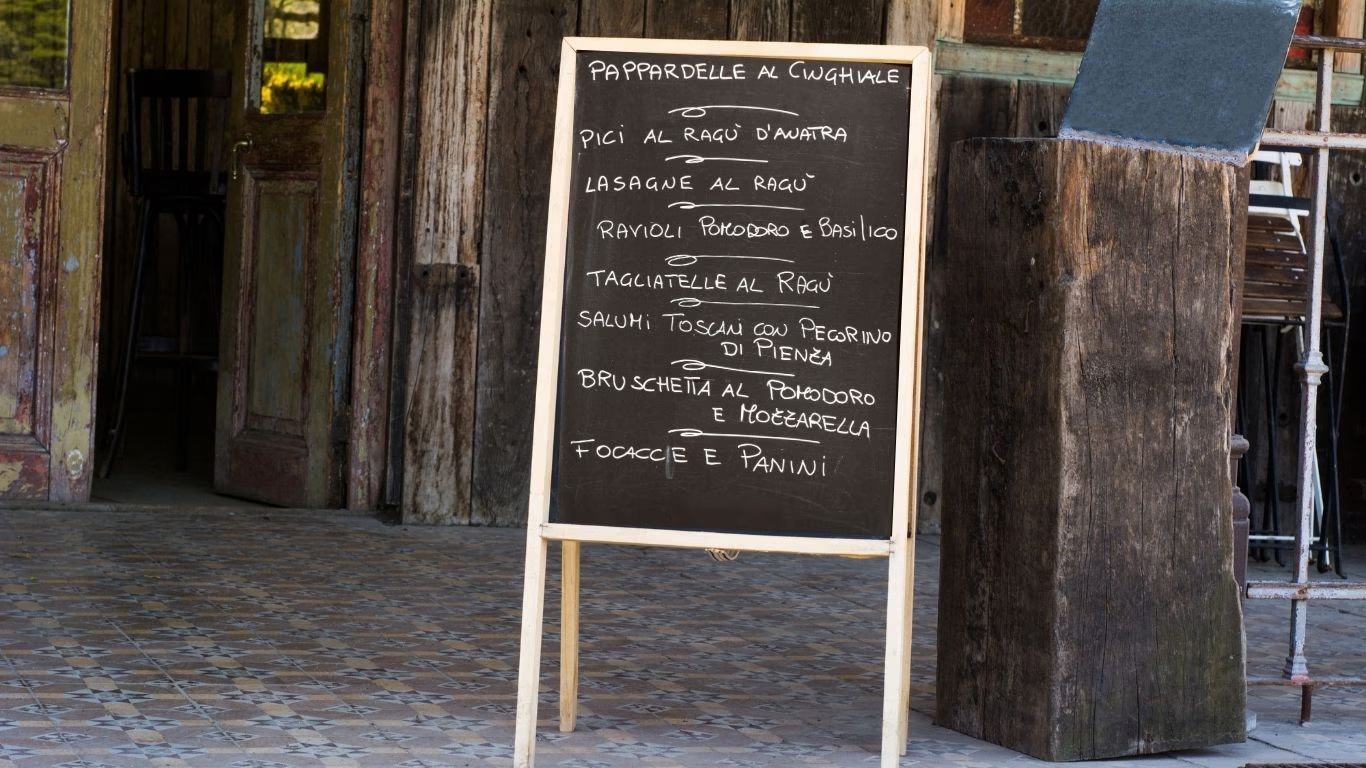
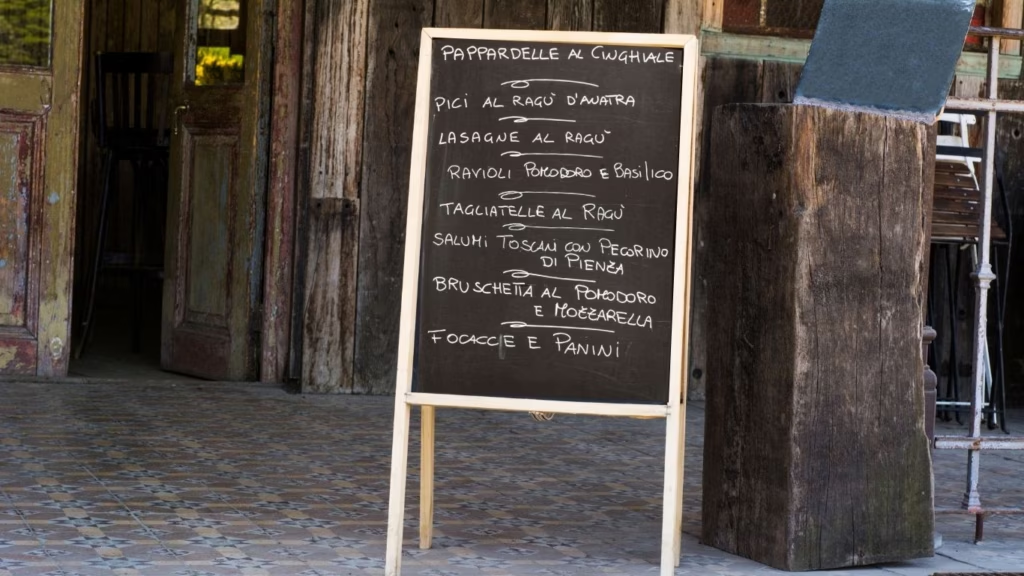
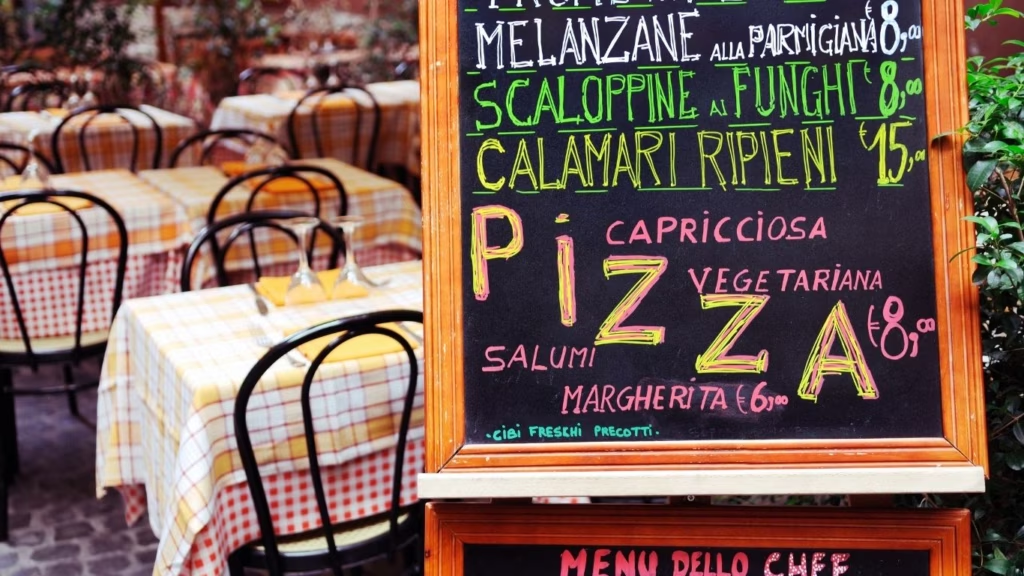
A laminated menu with photographs of a hundred dishes, or one printed in a dozen languages, tells you a decision the restaurant has already made about who it’s for. Real trattorie keep short cards, written in Italian, and let the words do the work, since there’s no need to tempt anyone with a picture when the writing is enough. The same goes for the plastic chef holding a board by the door, the flags of eleven nations, “tourist menu” printed in three of them, and trays of pre-cooked pasta sitting out in the warmth, waiting for whoever wanders past.
Then there’s the clock, which in Florence is about the most reliable instrument you have, because Florentines simply don’t sit down to dinner at six, and a dining room full at that hour is full of people who landed yesterday. That isn’t to say the city goes quiet in the meantime, quite the opposite: six o’clock is aperitivo, and it’s the loveliest hour here, long light, Campari, people standing about in the squares with no intention of going anywhere. Dinner just hasn’t started yet.
Nearness to the monuments doesn’t disqualify a restaurant, but it raises the bar considerably, since the closer you get to the Duomo, the harder a place has to work to deserve you when it doesn’t really need you to come back, because tomorrow brings another four thousand people just like you. Rents climb, tables turn faster, and quality is usually the first thing quietly set down.
One last sign, and it costs nothing to look for. If you pass somewhere at one o’clock on a Tuesday and the tables are full of people in work clothes eating quickly and paying without ceremony, put the name in your phone, because a place the neighbourhood eats at on a weekday is a place worth booking for a Saturday.
Then Read the Menu Properly
A frontage can be dressed up, but a menu is much harder to disguise, and it’s the point at which almost everyone stops looking anyway.
Start with what’s actually being cooked. Florentine food is specific, a little uncompromising, and it flatters nobody: crostini di fegatini, ribollita, pappa al pomodoro, trippa and lampredotto, peposo that’s been in the oven since morning, baccalà, pecorino, cardoons when the season allows. A Florence menu that opens with carbonara, lasagne and fettuccine Alfredo isn’t really a Florentine restaurant, however handwritten the card, so much as a greatest hits compilation assembled for an audience that won’t be back to complain.
Look, too, for the asterisks, those small stars beside a dish, with a line of fine print at the foot of the page. Under EU Regulation 1169/2011, a restaurant has to tell you when something has been frozen and defrosted, and Italy’s Court of Cassation confirmed in 2017 that leaving it off amounts to fraud. Frozen isn’t a sin in itself, since plenty of serious kitchens freeze fish and say so plainly, but a menu carrying seafood in every section without a single star anywhere is a question worth asking.
Then there’s the steak, which catches more people out than anything else on the page. Bistecca alla fiorentina is sold by weight, all’etto, per hundred grams, and those two words are often set rather smaller than the number sitting beside them. At around five and a half euros an etto, a 1.2kg steak comes to roughly sixty six euros, and plenty of places set a minimum weight or won’t cut one for a single diner. None of that is a trick, it’s simply how the dish has always worked, and being caught out by it when the bill lands on the one night you’d planned to be perfect is exactly what a trap is counting on. So ask the weight before it’s cut. A good kitchen will volunteer the weight, the breed and the price without being asked, and if they’ve hung the Vitellone Bianco dell’Appennino Centrale IGP mark on the wall, they’ll be glad to show you the certificate behind it.
It’s also worth knowing what the coperto is. It’s a cover charge, two or three euros a head, and it’s completely normal, which is exactly why it isn’t the green flag it’s sometimes made out to be, since traps charge it too. What matters is that it’s written down, because Italian law requires a venue to display the prices it applies, accessory charges included, so a coperto that only turns up at the end is worth querying, as is a servizio of ten or fifteen per cent stacked on top of one. Either on its own is ordinary. Both together, unannounced, tells you most of what you need to know. And if you’ve eaten in Rome and never met a coperto, that’s because Lazio banned it back in 2006.
The Signs of a Place Worth Your Evening
Enough about the warnings, because the other side is more pleasant, and easier to spot than most people expect.
Look for Italian listed first, on the page. If the dishes appear in Italian above the English, or with no English at all, locals are eating there. The cards tend to be short, handwritten or run off that same morning, three or four pastas and three or four mains, changing with whatever came in from the market. It’s worth listening, too, since staff talking to each other in Italian tells you who the room is really for, and staff greeting somebody by name tells you the rest.
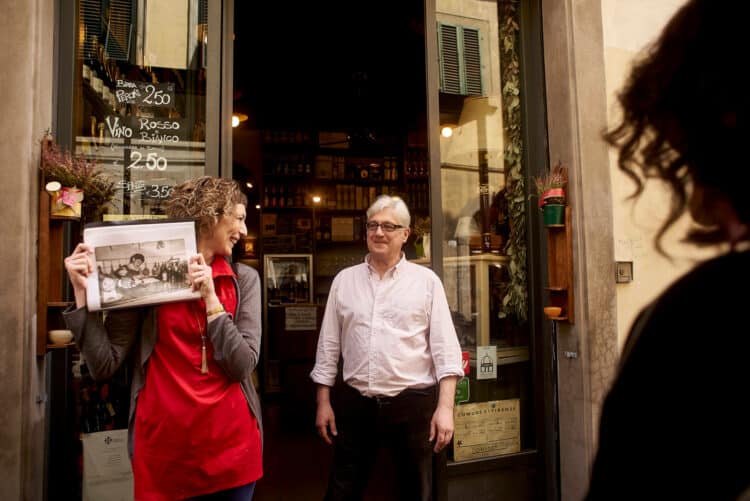
Check the window for the small stickers, buoni pasto, or “ticket restaurant,” the logos of the meal voucher schemes Italians use to pay for lunch. Almost nobody thinks to look for these, which is precisely why they’re honest, and a restaurant that takes meal vouchers is a restaurant where people who live here eat on a Wednesday.
Remember, too, that in Florence later is better, and the rooms that only come alive after eight are usually the ones Florentines have kept for themselves; we’ve written more about that hour in Florence After 8pm. If a place insists you book, take it as a compliment to the kitchen rather than an inconvenience, since it’s full on reputation alone, so reserve a few days out and be glad of it.
Even the booking itself tells you more than you’d think. Ring, or message, and notice whether they answer in Italian, then ask the real question: will they hold half past eight for two, or steer you gently towards a quarter to seven? A restaurant that keeps offering the early sitting is telling you, quite politely, which service it considers yours.
Come out with us one evening. If you’d rather not spend an afternoon of your holiday reading reviews, come out with us instead, and we’ll walk you through the Tuscan capital with somebody who already knows which doors to knock on and what’s behind them, so you can spend the evening eating alongside Florentines rather than working out where they are. Our Florence food tours hub has the full list.
Authentic Isn’t the Same as Right for the Night
Here’s the part almost nobody mentions, and if you’re planning an occasion it matters more than everything above it.
Every test on this page proves a restaurant is genuine, but not one of them proves it’s right for your evening. A thoroughly authentic Florentine trattoria can be strip lit and loud as a school hall, your chair back touching a stranger’s, the room turned twice before eleven, which is wonderful on a Tuesday lunchtime and quietly, unfixably wrong for an anniversary. It’s entirely possible to follow every rule here to the letter and still book the wrong room.
So when the evening has to land, there are three more things worth asking. Ask whether there’s a second sitting, avete un secondo turno, because if they need the table back by half nine you’ll be eating against a clock, and you’ll feel it somewhere around the secondi, plates arriving a beat too quickly, a pause before anyone mentions dessert. Places that seat only once a night will usually tell you so happily, and that’s the answer you want.
Ask about the room, too. A corner table, or one away from the door and the service station, is a small thing to request and it changes the entire evening, and better still, walk past at eight and look through the glass, since ten seconds at a window teaches you more about light, noise and the distance between tables than an hour of anybody’s reviews.
And ask whether the outside table is worth what it faces. Terraces are the great Florentine bargain, and sometimes a genuinely good one, a quiet square in Oltrarno in June with the stone still holding the day’s heat is about as good as dinner gets, but a table on a thoroughfare, with scooters and tour groups passing behind your wine, is a worse seat than the one inside, and it’s also, almost always, the one they’ll offer you first.
The 30-Second Checklist Before You Sit Down
Red flags
- Someone out front asking you to come in
- Photo menus, laminated menus, or menus in a dozen languages
- A dining room full at six o’clock
- Carbonara and lasagne leading a Florence menu, with no Tuscan dishes on it
- Seafood in every section and not an asterisk in sight
- A coperto that isn’t written anywhere, or a servizio stacked on top of one
- Plastic chef statues, world flags, trays of pre cooked pasta by the door
- Wide open availability at prime time on a Saturday
Green flags
- Italian listed above English, on a short card that changes
- Staff speaking Italian to each other, and greeting regulars by name
- Buoni pasto / “ticket restaurant” stickers in the window
- Full of people in work clothes at one o’clock on a weekday
- Only filling up after half past seven or eight
- Booking required, and they’ll hold 8.30 rather than push you to 6.45
- Bistecca priced clearly per etto, with the weight offered before it’s cut
- Listed on Vetrina Toscana
- In Oltrarno, San Frediano or Sant’Ambrogio rather than on a monument corridor
Where to Eat in Florence Instead
All of this gets easier once you start in the right part of town. Ask where locals eat in Florence and you’ll get a short list back, and hardly any of it sits in the centre.
The corridors worth being sceptical of are the obvious ones, the terraces ringing Piazza del Duomo, Via de’ Calzaiuoli running down to the Signoria, the edges of the Signoria itself, and the streets immediately outside Mercato Centrale. There’s good food along all of them, but there’s also a great deal of the other kind, and the two are harder to tell apart there than anywhere else in the city.
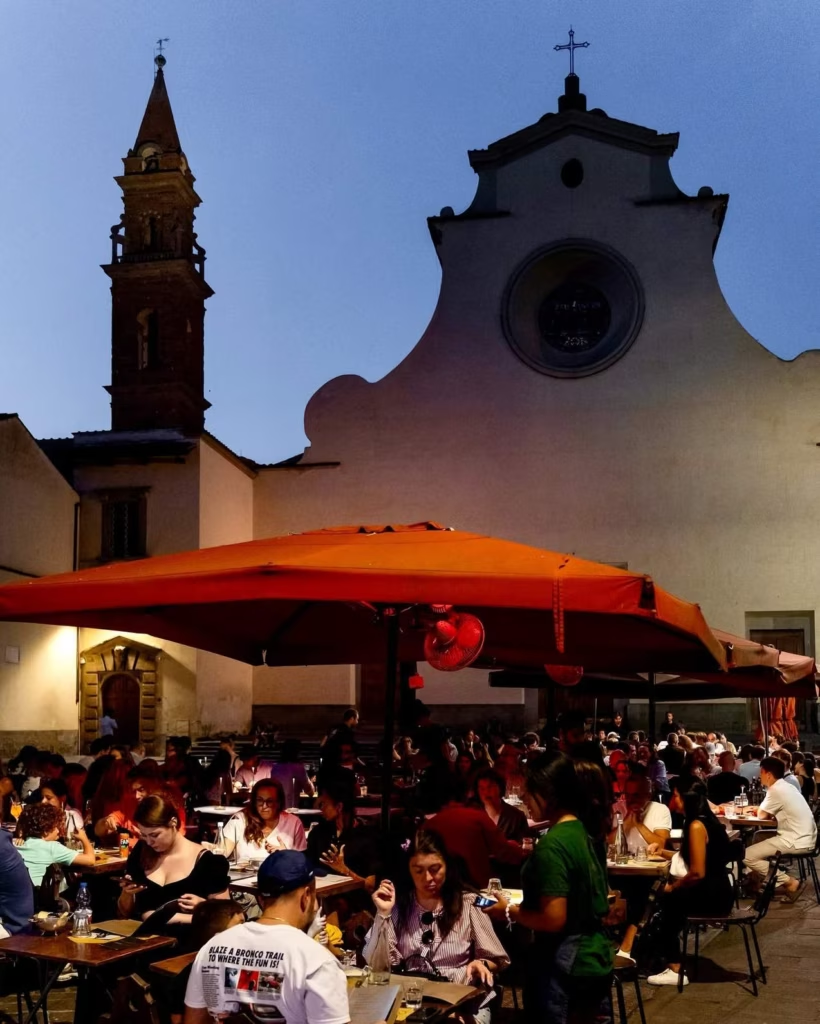
So cross the river. Oltrarno and San Frediano are where the workshops still are, gilders and cobblers and frame makers working at street level with their doors propped open, and where restaurants seat thirty rather than three hundred. Squares like Santo Spirito fill with locals at aperitivo and never really empty. Back on the north bank, Sant’Ambrogio is the quietest good decision in Florence, a working market with a real neighbourhood wrapped around it, ten minutes on foot and a whole world away from the Duomo, and it’s exactly the kind of ground we cover in Florence After the Guidebook. If you’re weighing the two markets against each other, we’ve compared them properly in Sant’Ambrogio vs Mercato Centrale.
And one shape for the evening, since the city won’t feed you before eight anyway: aperitivo at half six, in Santo Spirito or by the market at Sant’Ambrogio, then a slow wander while the light turns amber and then blue and the swifts come out over the rooftops, with dinner at half past eight. That isn’t a compromise with the local timetable, it is the local timetable, and it happens to contain the two most romantic hours of the Florentine day.
How We Choose the Rooms We Take You To
Sometimes you find the place by accident and it becomes the story you tell about the whole trip, and other times you eat something forgettable on the one night that mattered. In a city this visited, dinner can feel like a wager, and on an evening you’ve built a trip around, a wager is the last thing you want to be making at seven o’clock with a phone in your hand.
That’s where we come in. We don’t choose a restaurant and move on, we go back, and back again, to see whether it holds, and the relationships we have with the people cooking are measured in years rather than visits. Which means that when we bring you somewhere, we already know what that room feels like at half past eight on a Thursday, not just how the food photographs.
So rather than spending an afternoon of a short holiday working it out for yourself, come out with us and find the work already done. You’ll sit down in trattorie and markets like Sant’Ambrogio and Mercato Centrale, eat things most visitors never find, and meet the people who made them, which, if we’re honest, is the part we care about most.
Frequently Asked Questions
Is it safe to eat near the Duomo at all? Yes, there’s nothing wrong with the postcode, the bar is simply higher there, because those restaurants don’t need you to come back. Run the place past the checklist above, and if two or three red flags come up, keep walking, since five minutes in any direction usually improves your odds considerably.
What time should I book dinner in Florence? Aim for eight or half past, since that’s when Florentines eat and when the good rooms come alive. Book two or three days ahead for a weekday, and up to a week for a Friday or Saturday in high season, and if a restaurant only offers a quarter to seven, that usually tells you which sitting they’ve set aside for visitors.
Do I need to speak Italian to eat where locals eat? No. Vorrei… or Posso avere… followed by the name of the dish will carry you through, and pointing works perfectly well too. Plenty of people in Florentine hospitality speak some English, and a little effort in Italian is met warmly almost everywhere, usually with more patience than you were expecting.
What’s the easiest way to find authentic places on a short trip? Pick one neighbourhood and stay in it. Choose Oltrarno or Sant’Ambrogio, book two restaurants there before you fly, and cross check them against the Vetrina Toscana directory, since you’ll eat better on three nights in one district than chasing a different famous name across the city each evening, and by the third night people start recognising you, which is when Florence really opens up.
Let us take the guesswork out of one Florence evening, join a small group food tour and taste the city the way it’s meant to be tasted.
Sources
Comune di Firenze. (n.d.). FeelFlorence: The official tourism website of the Municipality and Metropolitan City of Florence. https://www.feelflorence.it/en
Consorzio di Tutela Vitellone Bianco dell’Appennino Centrale IGP. (n.d.). Vitellone Bianco dell’Appennino Centrale IGP. https://www.vitellonebianco.it/en/
European Parliament and Council of the European Union. (2011). Regulation (EU) No 1169/2011 of 25 October 2011 on the provision of food information to consumers. EUR-Lex. https://eur-lex.europa.eu/legal-content/EN/TXT/?uri=CELEX%3A32011R1169
Regione Toscana & Unioncamere Toscana. (n.d.). Vetrina Toscana. https://www.vetrina.toscana.it/en/
Toscana Promozione Turistica. (n.d.). Visit Tuscany: The official tourism website of Tuscany. https://www.visittuscany.com/en/

Florence Sunset® Food & Wine Tour
An unforgettable evening filled with wines, fresh pasta, cocktails and an exclusive wine cellar experience.
- Daily
- 3.5 Hours
- Small Group
Florence Food & Local Flavors Tour
An intimate culinary experience through Oltrarno, among Tuscan flavors and legendary local hosts
- Mon-Sat
- 3 Hours
- Small Group
Tuscany Truffle Hunt: A Culinary Adventure
A gourmet culinary adventure with a multi-course meal in the Tuscan countryside.
- 5 Hours
- Small Group